.."show-off" every time I visualise my arguments...
I find that to be a strange comment. I do not see these or any of your renderings as show-off. The images and text are highly relevant to why this thread started: the effects of reducing model size and rely on s 1 smoothing. High quality images with background and light sources reveal issues that I would not discover in my 900×600 renders. So thanks, for me this is very useful. And, btw, even if the posts were show-off, that would still be fine. Of course, users wish to show stuff they are proud of and get a pat on the back as acknowledgement. Forum would not be the same without them...tiny difference, a difference really not worth mentioning ... 8 by 3 meter poster, where every tiny detail becomes visible...
But it is worth mentioning. Again, it all depends on the purpose. No cheating: for high quality print other formats and higher resolutions are essential. Just got some A5 signs back from a print shop based on a vector original. Result was perfect, as it should be, even if I doubt anyone else would have noticed. So I agree, no short-cuts when it comes to the real stuff.But that also means I should explain my preference for low-quality graphics in the models: It is unlikely I will ever use the original texture again. The working texture is just a place-holder for texture mapping. As the original model is saved in the .sh3d file, there is no point in including high-res graphics I will not need. Later, when I next need a bottle, I will apply a new texture in SH3D. At whatever resolution I require. Much tidier. So for each model, I tend to save a texture template for easy editing later (along with the original model file, but I do not put these in the zipped model file). Such as the AnyLabel in the first post. can_label_txt.svg
An .svg file that is easy to change into anything I like, at any resolution I need.
Like these two models with different textures and colours: Can to the left only has the holding texture, the three to the right have altered textures. Bottle same thing, original with small label to the left, changed colours and label to the right.
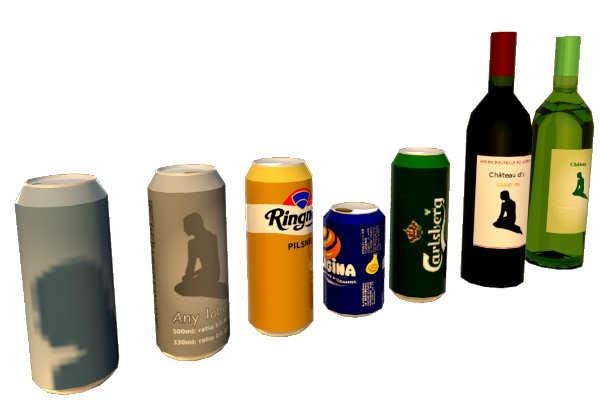
Actually, all the textures in this example are rubbish, mock-ups made in a couple of minutes, but that is not the point, it is possible to replace them with decent ones.
The elephant in the file is the .png label, an optimizer shrinks it to 11% without quality loss
Not entirely true. ... But you could say; "with little and barely noticeable quality loss.", and still have kept your words intact.If I was to print a high quality image of this bottle, I would rather increase than reduce the resolution of the .obj-file
Obviously you wish to use the resolution necessary to get the result you wish. And in some cases, I suppose that will require a higher resolution model. But I also think there is a point where it is impossible to tell the difference, i.e. where the s 1 smoothing produces a result identical to a high number of edges. At least seen from the side.If you were to drink a bottle of Tignanello 2012, would you be happy to be served a reduced and watered down version?
No. Absolutely not. Having had teen-agers in the house, watering down brings shivers down my spine. I gladly forgive nicking a taste or two, but trying to conceal theft with water is another story... Then again, I gladly drink a cheap, simple wine if it serves my purpose and pleases me. At a recent dinner party, expensive wine was served, everyone else seemed to love it. Tasted horrible, the back-up bag-in-box was infinitely better with the spicy food served. But that was me. Purpose and personal taste. ok
PS
@bdfd: nice compliment coming from you
Looked at your bottle. .obj pretty effective and just plastering the entire model with an image is an interesting approach. But I am not sure how you would go about testing the optical density at close-up using a full texture?